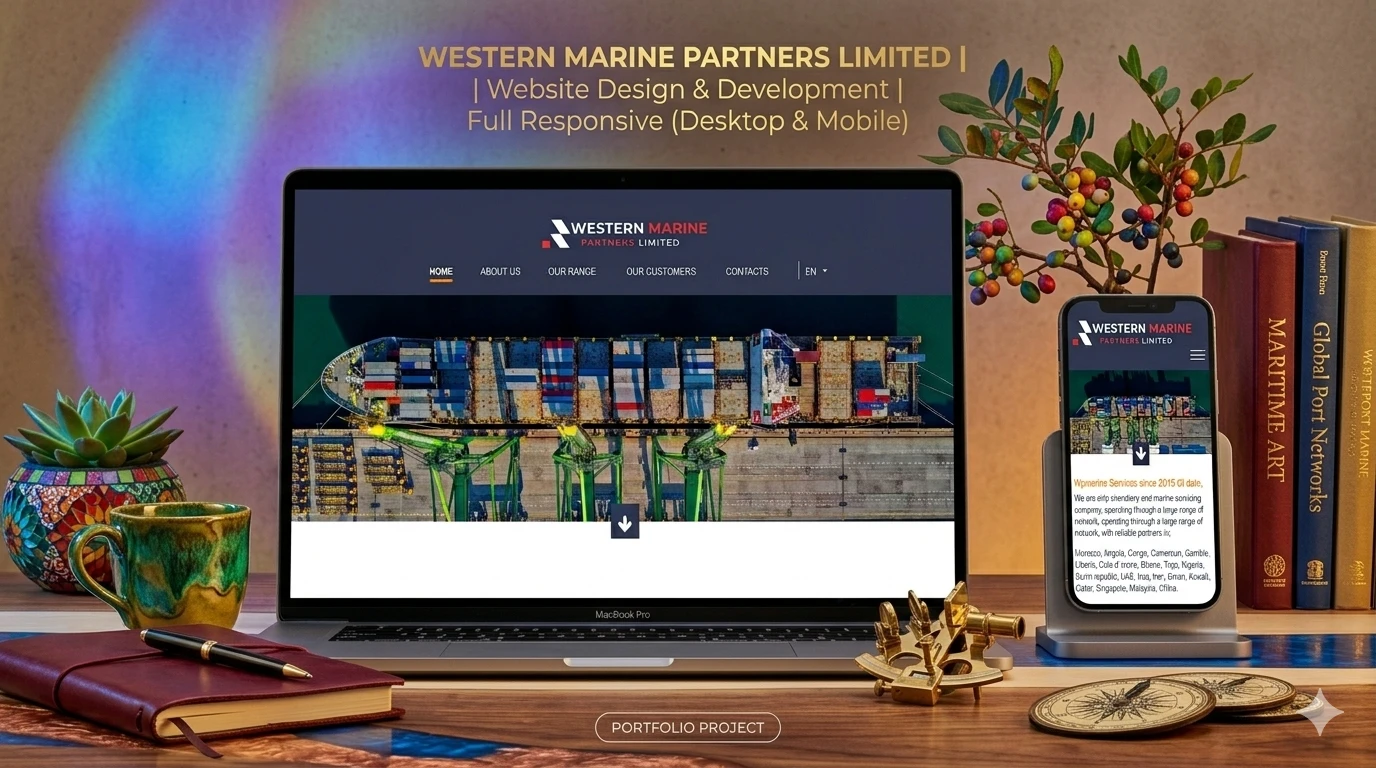
This breakdown highlights the business realities of the maritime and ship chandlery industry while positioning your engineering choices as the ultimate high-performance solution.
1. The Challenge
Before upgrading their digital presence, Western Marine Partners Limited operated with an outdated, static, and non-responsive legacy system that failed to match the scale of their multinational operations.
As a leading ship chandlery and marine servicing company anchoring in ports across over 20 countries—including Morocco, Ghana, Nigeria, UAE, and Singapore—their major roadblocks included:
-
Poor Mobile Accessibility for Crews at Sea: Port captains, logistics coordinators, and vessel crews frequently try to coordinate critical provisioning (like fresh water, provisions, and bunkering) from mobile devices or low-bandwidth maritime networks. The old interface was completely broken on mobile viewports, leading to fragmented communication and lost service inquiries.
-
Lack of Multilingual Global Trust: Operating across diverse international territories (from West Africa to the Middle East and Asia) requires localized confidence. The absence of a robust, seamless multilingual framework meant international shipping lines couldn't easily verify their local port capabilities, anchors, and service ranges.
-
Underrepresented Service Scope: Their extensive logistics capabilities—ranging from foodstuff supply chain management to complex technical garbage/oily waste disposal—were buried in unstructured layouts, failing to communicate operational readiness to enterprise maritime clients.
2. The Solution
To solve these global logistics friction points, I engineered a high-performance, fully responsive web infrastructure optimized for the modern maritime sector. Key architectural and design decisions included:
-
Mobile-First Responsive Layout: Rebuilt the front-end interface using a mobile-first philosophy. This guarantees that vessel operators and port agents can flawlessly navigate the entire service deck, view technical supply ranges, and seamlessly extract contact channels even on hand-held devices under erratic port network conditions.
-
Zero-Friction Internationalization (i18n): Implemented a lightweight, robust language-switching architecture right in the global navigation block. This provides instant localization for cross-border maritime partners, ensuring zero friction when corporate procurement teams evaluate their regional compliance and port networks.
-
Enterprise Asset & Service Structuring: Designed a clean, high-impact visual grid that instantly categorizes their distinct service categories (Foodstuff, Supply Chain & Logistics, Technical, and Bunkering). By incorporating clean iconography and geographic data tagging for all operational ports from Asia to Africa, the platform now drives immediate customer trust and accelerates the B2B inquiry-to-delivery pipeline.
This project was developed using PHP, HTML, Bootstrap CSS, and MySQL. PHP was used for the server-side application logic, HTML5 and Bootstrap CSS were utilized to create a responsive and user-friendly interface, while MySQL served as the database management system for secure and efficient data storage.