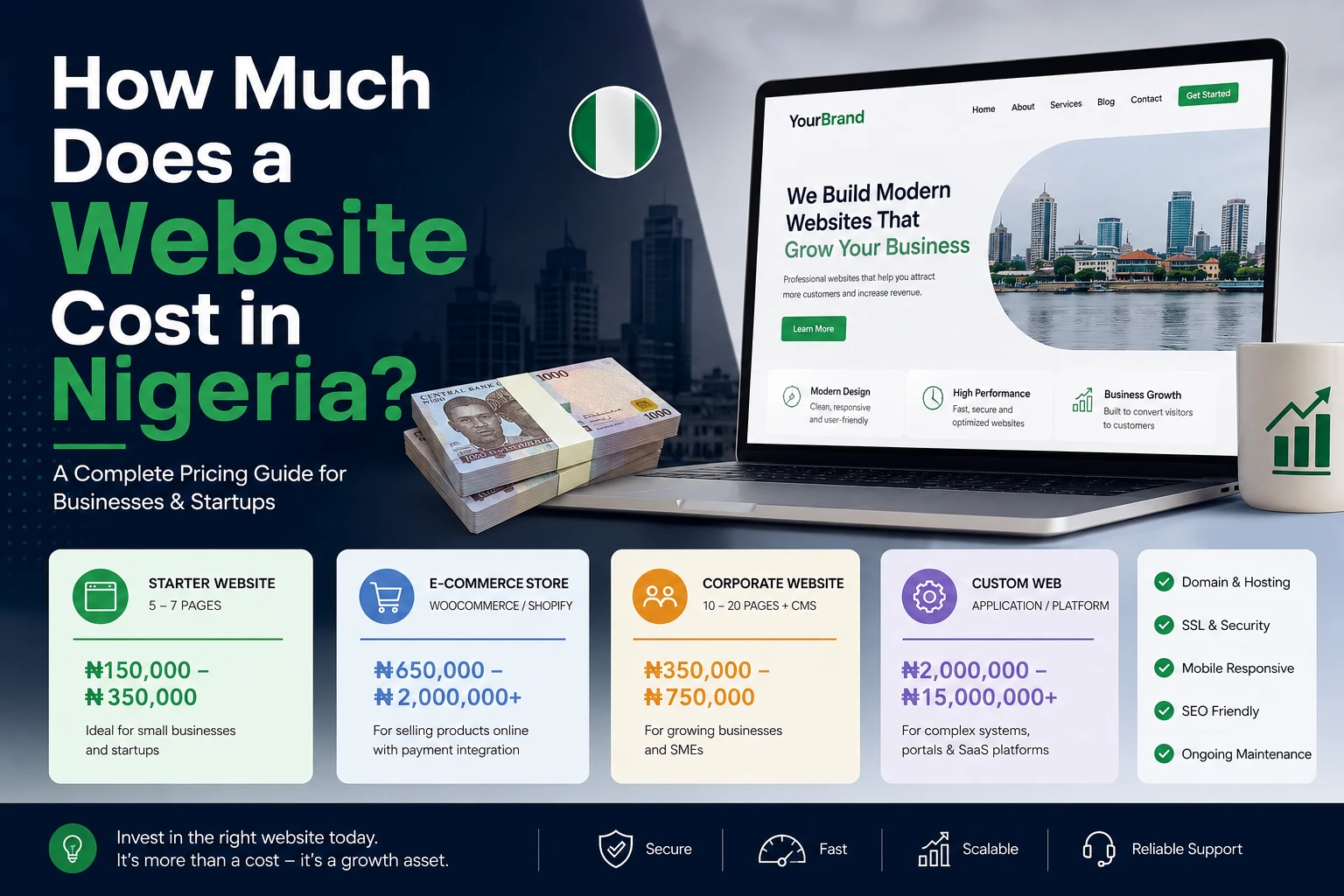
How Much Does a Website Cost in Nigeria?
If you’ve ever requested a website quote in Nigeria, you’ve probably seen something confusing:
One developer says ₦50,000. Another quotes ₦750,000. An agency sends ₦5,000,000+ for what appears to be “the same website.”
So what exactly is happening?
The truth is: website pricing in Nigeria is not random. The difference comes down to infrastructure, design quality, development standards, scalability, security, functionality, and long-term business value.
A website is not just pages on the internet—it is often your sales office, customer acquisition channel, support system, and digital reputation combined.
This guide breaks down the real cost of building a website in Nigeria so you can make an informed investment and avoid expensive mistakes.
Why Website Prices Vary So Much in Nigeria
Many business owners compare websites the same way people compare smartphones—assuming appearance equals capability.
Two websites may look similar on the surface but differ significantly underneath:
-
One may use a generic template with poor optimization.
-
Another may be custom-built for speed, SEO, security, and future growth.
-
One may break after six months.
-
Another may run efficiently for years.
Understanding pricing starts with understanding the layers involved.
1. Core Infrastructure Costs (Recurring Annual Expenses)
Before design or development begins, every website requires digital infrastructure.
These are ongoing yearly costs.
| Component | Typical Annual Cost (NGN) | What It Covers |
|---|---|---|
| Domain Name (.com.ng) | ₦5,000 – ₦15,000 | Local Nigerian business identity |
| Domain Name (.com) | ₦15,000 – ₦25,000 | Global branding and broader trust |
| Shared Hosting | ₦30,000 – ₦120,000 | Entry-level hosting for small websites |
| Cloud / VPS Hosting | ₦150,000 – ₦500,000+ | Higher performance and scalability |
| SSL Certificate & Security | Free – ₦250,000+ | HTTPS encryption and advanced security |
Domain Selection: Local vs Global
For businesses focused primarily on Nigerian customers:
-
.com.ng is often more cost-effective.
-
Signals local presence.
For businesses targeting international clients:
-
.com often creates broader brand flexibility.
Hosting Matters More Than Most People Think
Hosting determines:
-
Website speed
-
Uptime reliability
-
Security
-
Ability to handle traffic spikes
A cheap host may save money initially but cost sales through slow loading times.
2. Website Development Cost Breakdown by Project Type
This is where most of the budget differences happen.
Website Design Cost in Nigeria by Project Tier
| Website Type | Estimated Cost (NGN) | Ideal For | Key Features |
|---|---|---|---|
| Starter Business Website (5–7 pages) | ₦150,000 – ₦350,000 | Small businesses, personal brands | Responsive design, contact forms, service pages |
| Advanced Corporate / SME Website (10–20 pages) | ₦350,000 – ₦750,000 | Growing businesses | CMS, blog, SEO structure, lead generation |
| E-Commerce Website | ₦650,000 – ₦2,000,000+ | Retail, product businesses | Payment integration, inventory, order tracking |
| Custom Web Platform / SaaS / Portal | ₦2,000,000 – ₦15,000,000+ | Startups and enterprise systems | Custom architecture, dashboards, automation |
Starter Business Website (₦150k–₦350k)
Best for:
-
Consulting firms
-
Small service businesses
-
Professional portfolios
-
Local businesses
Usually includes:
-
Homepage
-
About page
-
Services
-
Contact page
-
Mobile responsiveness
-
Basic SEO setup
This category prioritizes credibility and online presence.
Advanced Corporate / SME Website (₦350k–₦750k)
Ideal for businesses operating in places like:
-
Lagos
-
Abuja
-
Port Harcourt
Typical features:
-
Blog functionality
-
Content Management System (CMS)
-
Team profiles
-
Conversion-focused landing pages
-
Analytics integration
This is often the sweet spot for established SMEs.
E-Commerce Website (₦650k–₦2M+)
Online stores require significantly more engineering.
Typical inclusions:
-
Product catalog
-
Cart functionality
-
Checkout flow
-
Payment gateways
-
Customer account system
-
Order management
Pricing increases with:
-
Number of products
-
Custom features
-
Inventory automation
-
Delivery integration
Custom Web Platforms & SaaS (₦2M–₦15M+)
This category covers systems built from the ground up.
Examples:
-
Banking dashboards
-
Logistics platforms
-
Booking engines
-
Marketplace platforms
-
Learning management systems
-
Internal business portals
Typical technologies may include:
-
Laravel
-
Next.js
-
Custom APIs
-
Cloud infrastructure
This is where custom web application pricing becomes highly dependent on business goals.
3. Agency vs Freelancer vs Cheap “Template Dumps”
One of the biggest pricing decisions is who you hire.
| Option | Typical Cost | Advantages | Risks |
|---|---|---|---|
| Freelance Web Designer | ₦150k – ₦800k+ | Lower overhead, flexibility | Capacity limits, support variability |
| Specialized Agency / Digital Solutions Provider | ₦500k – ₦10M+ | Structured process, support, scalability | Higher investment |
| Ultra-Cheap Template Sites | ₦50k – ₦100k | Fast delivery | Long-term technical debt |
The Hidden Cost of the ₦50,000 Website
Low-cost websites often become expensive later.
Common issues include:
-
Weak security practices
-
Slow performance
-
Poor mobile responsiveness
-
Broken layouts across devices
-
No SEO architecture
-
No backups
-
No technical support
Many businesses end up rebuilding within 12–18 months.
That means paying twice.
4. Features That Increase Website Pricing
The final quote depends heavily on functionality.
Payment Gateway Integration
Examples include:
-
Paystack
-
Flutterwave
Complex pricing factors:
-
Subscription billing
-
Wallet systems
-
Split payments
-
Financial reporting
User Management & Role-Based Access Control (RBAC)
Examples:
-
Admin dashboards
-
Staff permissions
-
Customer accounts
-
Multi-level approvals
More permissions = more development logic.
Real-Time Systems & Automation
Examples:
-
Live notifications
-
Workflow automation
-
CRM integration
-
Inventory synchronization
-
Third-party APIs
These features significantly increase development complexity.
5. Website Maintenance & Post-Launch Costs
Launching a website is the beginning—not the end.
Like a physical office, websites require maintenance.
Typical Website Maintenance Costs (NGN)
| Maintenance Type | Annual Cost |
|---|---|
| Basic Maintenance | ₦50,000 – ₦150,000 |
| Business Maintenance | ₦150,000 – ₦300,000 |
| Enterprise Support | ₦300,000 – ₦500,000+ |
Maintenance usually includes:
-
Security updates
-
Performance optimization
-
Backups
-
Bug fixes
-
Content changes
-
Software upgrades
-
Monitoring and uptime checks
These website maintenance costs (NGN) protect your digital investment.
How to Decide the Right Budget
Ask these questions:
-
Is this website meant to generate revenue?
-
Will customers interact with it regularly?
-
Will it need future upgrades?
-
How important is speed and reliability?
If the answer is yes to most of these, prioritize value—not the lowest quote.
Final Thoughts: A Cheap Website Can Become an Expensive Mistake
So, how much does a website cost in Nigeria?
For most businesses:
-
Expect ₦150,000–₦750,000 for professional business websites.
-
Expect ₦650,000–₦2,000,000+ for e-commerce.
-
Expect ₦2,000,000+ for custom platforms and scalable systems.
The cheapest option often becomes the most expensive after redesigns, lost customers, poor SEO, downtime, and rebuilding.
Treat your website as a business asset—not a one-time expense.
If you're planning to build or upgrade your website, partner with a technical team that focuses on scalable, secure, production-ready systems aligned with your business objectives and long-term growth goals.


Comments: