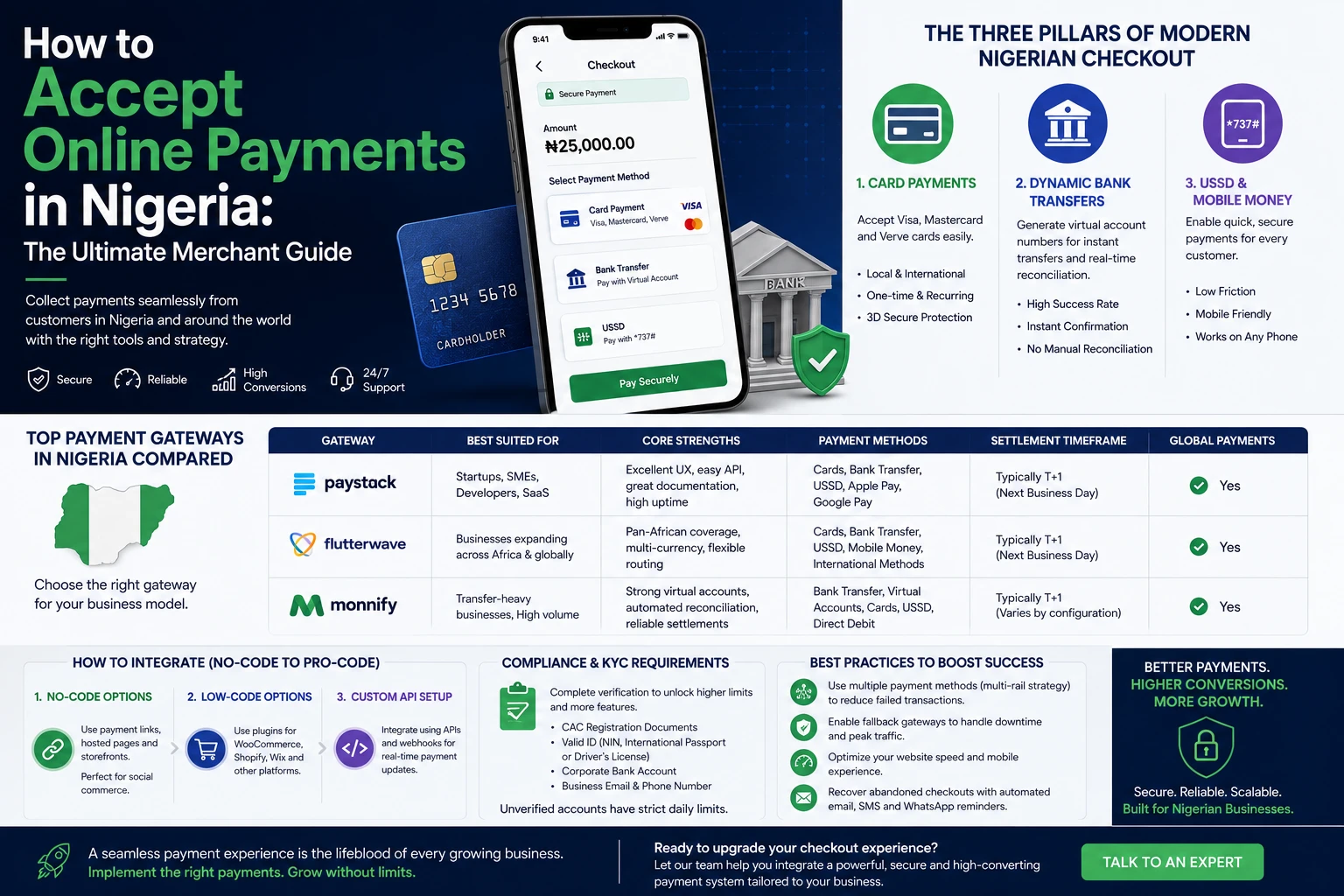
How to Accept Online Payments in Nigeria: The Ultimate Merchant Guide
Every Nigerian business owner selling online eventually experiences this frustrating moment:
A customer adds products to cart.
Clicks Pay Now.
The transaction fails.
They refresh once.
Try again.
Then disappear.
That’s revenue gone—not because customers weren’t interested, but because the checkout experience broke.
For Nigerian merchants today, accepting online payments successfully is no longer about adding a single card processor and hoping for the best.
Modern high-converting businesses use a multi-rail payment strategy—combining cards, dynamic bank transfers, and USSD/mobile payments to maximize successful transactions and reduce checkout abandonment.
Whether you run an e-commerce store, SaaS product, consulting company, subscription platform, or digital marketplace, this guide explains exactly how to accept online payments in Nigeria the right way.
1. The Three Pillars of Modern Nigerian Checkout
If your checkout only accepts one payment method, you are losing customers.
Modern Nigerian payment experiences should support multiple rails.
1. Card Payments (Visa, Mastercard & Verve)
Card payments remain one of the most familiar methods for customers.
Your checkout should ideally support:
-
Visa
-
Mastercard
-
Verve (critical for Nigerian market coverage)
Best For:
-
E-commerce
-
Subscription services
-
SaaS billing
-
Digital products
Advantages:
-
Fast checkout
-
International customer support
-
Recurring payment capability
Common Challenges:
-
Bank authorization failures
-
Card declines
-
OTP friction
-
Temporary issuer downtime
Cards are important—but they should never be your only payment method.
2. Dynamic Virtual Bank Transfers
This is one of the fastest-growing payment rails in Nigeria.
Here’s how it works:
Instead of asking customers to manually upload payment proof, your payment system instantly generates a temporary account number.
Customer flow:
-
Select Pay via Bank Transfer
-
Receive dedicated transfer account
-
Complete transfer
-
System detects payment automatically
-
Order gets confirmed instantly
This process is called automated reconciliation.
Why Merchants Love It
-
Extremely high success rates
-
Lower payment friction
-
Excellent for high-volume stores
-
Reduces failed card transactions
This model has become a major competitive advantage for Nigerian checkout systems.
3. USSD & Mobile Money
USSD remains essential.
Not every customer wants to enter card details.
USSD allows customers to:
-
Approve payments directly from banking apps
-
Complete transactions quickly
-
Reduce checkout abandonment
Best For:
-
Mobile-first businesses
-
Service providers
-
Regional commerce
Your goal should be payment flexibility—not forcing customers into one path.
2. Deep Comparison of Top Payment Gateways in Nigeria
Choosing the best payment gateway in Nigeria depends on your business model.
Below is a practical comparison.
| Provider | Best Suited For | Core Strengths | Settlement Timeframe |
|---|---|---|---|
| Paystack | SMEs, startups, developers | Excellent checkout UX, clean API, strong documentation | Typically T+1 |
| Flutterwave | International growth & Pan-African operations | Multi-country support, broad payment rails, routing flexibility | Typically T+1 |
| Monnify | Transfer-heavy businesses | Strong virtual accounts, automated reconciliation, bank transfer optimization | Often T+1 (varies by configuration) |
Paystack
Strong choice for:
-
SaaS startups
-
Online stores
-
Service businesses
Advantages:
-
Easy onboarding
-
Strong developer tools
-
Excellent user experience
Flutterwave
Strong choice for:
-
International payments
-
Regional expansion
-
Multi-currency operations
Advantages:
-
Broad market reach
-
Global acceptance
-
Extensive payment options
Monnify
Strong choice for:
-
Virtual accounts
-
Recurring transfer workflows
-
Transfer-first checkout experiences
Advantages:
-
Excellent reconciliation workflows
-
Efficient transfer collection
This is why many businesses evaluating Paystack vs Flutterwave vs Monnify increasingly combine multiple providers.
3. Step-by-Step Integration Framework (No-Code → Pro-Code)
Your implementation path depends on technical capability.
Option 1: No-Code Setup
Perfect for:
-
Instagram vendors
-
WhatsApp commerce
-
Solo entrepreneurs
Methods:
-
Hosted payment pages
-
Payment links
-
Storefront tools
Typical flow:
Customer → Payment Link → Checkout → Confirmation
Fast to launch.
Minimal technical work.
Option 2: Low-Code Integrations
Ideal for merchants using:
-
WooCommerce
-
Shopify
-
Wix
Typical process:
-
Install official plugin
-
Connect merchant account
-
Configure callback URL
-
Test transactions
-
Go live
This is usually enough for most SMEs.
Option 3: Custom API Integration
Best for:
-
Custom web applications
-
SaaS platforms
-
High-volume operations
Popular stacks:
-
Laravel
-
Next.js
-
Python frameworks
Recommended architecture:
Frontend → Gateway API → Webhooks → Database → Customer Notification
Why Webhooks Matter
Webhooks allow your system to:
-
Confirm payments instantly
-
Update order status
-
Trigger fulfillment
-
Send receipts automatically
This creates reliable online payment checkout solutions.
4. Navigating Regulatory & Compliance Requirements
Payment providers in Nigeria must comply with regulatory requirements.
To unlock higher transaction limits and business features, merchants typically complete advanced verification.
Typical Requirements for Tier 3 KYC & Compliance
Business Documentation
-
CAC registration documents
-
Certificate of incorporation
-
Business registration details
Identity Verification
Provide one valid ID:
-
NIN
-
International Passport
-
Driver’s License
Banking Requirements
-
Corporate bank account
-
Matching business information
Contact Verification
-
Business email
-
Phone number
-
Address validation
Why Verification Matters
Verified businesses generally unlock:
-
Higher transaction limits
-
Faster settlements
-
Expanded payment features
Unverified accounts may operate with stricter limits and restrictions.
5. Best Practices to Eliminate Failed Transactions
Your checkout experience directly affects revenue.
These improvements can increase payment success rates.
Use Secondary Gateway Failover
Do not depend on one provider.
Example:
Primary Gateway → Failure → Automatic Secondary Gateway
Redundancy improves resilience.
Optimize Website Performance
Slow websites kill conversions.
Focus on:
-
Fast page loads
-
Mobile responsiveness
-
Efficient server response times
Recover Abandoned Checkouts
Automate reminders via:
-
Email
-
SMS
-
WhatsApp notifications
Small recovery improvements create meaningful revenue gains.
Monitor Payment Analytics
Track:
-
Success rate
-
Gateway uptime
-
Failed transaction patterns
-
Device conversion trends
Data reveals hidden bottlenecks.
Final Thoughts: Payments Are Not a Feature—They’re Infrastructure
A seamless payment system is the lifeblood of every growing digital business.
The businesses scaling fastest in Nigeria are not relying on one payment method.
They combine:
✔ Card Payments
✔ Dynamic Bank Transfers
✔ USSD Checkout
✔ Automated Reconciliation
✔ Smart Checkout Recovery
If your current checkout feels slow, unreliable, or dependent on one gateway, now is the time to audit it.
Partner with a professional web development team to implement a secure, scalable, multi-rail payment system engineered for higher conversion, smoother customer experiences, and long-term business growth.


Comments: