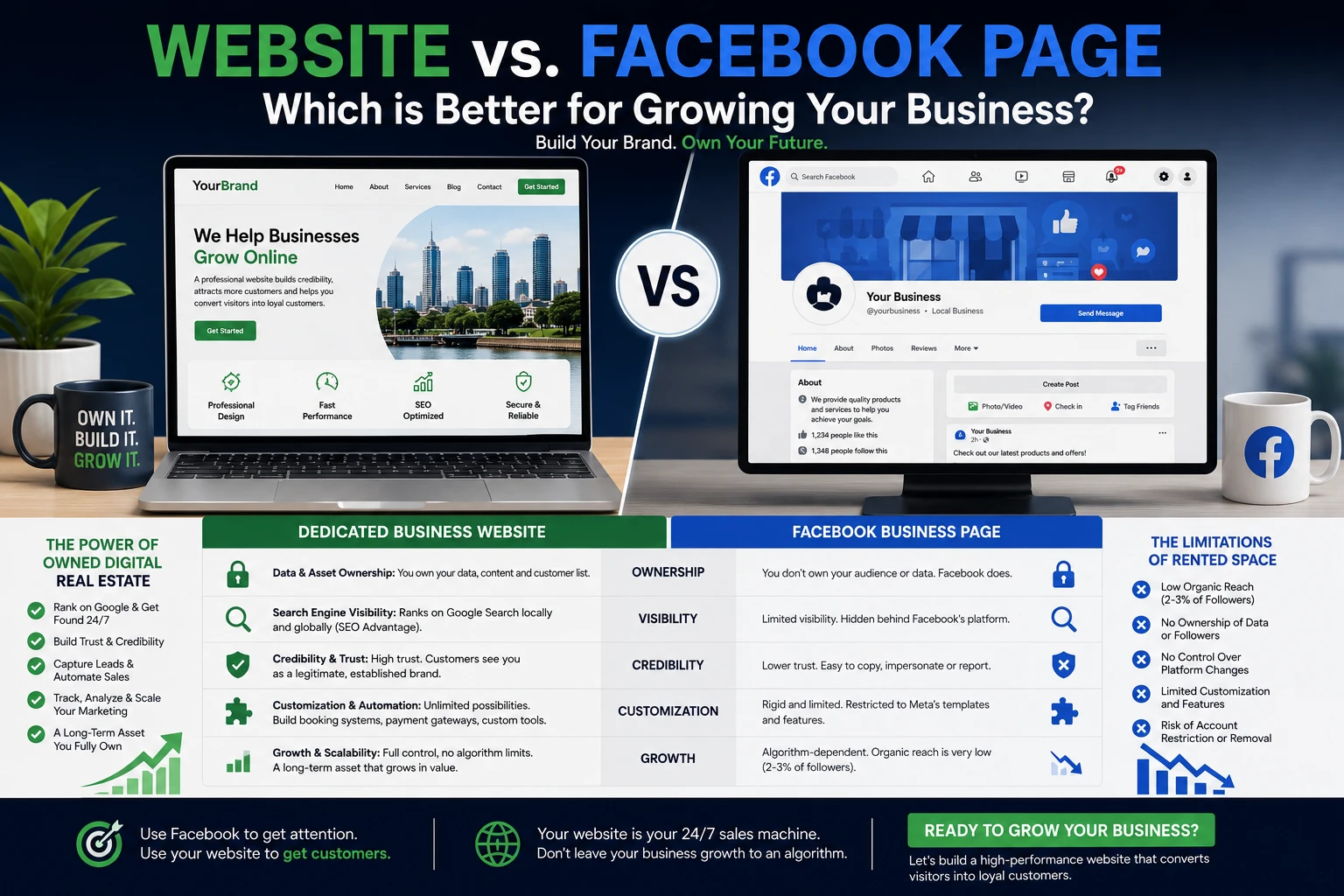
Website vs. Facebook Page: Which is Better for Growing Your Business?
Picture this.
A business owner launches a beautiful Facebook Business Page.
They upload a logo.
Invite friends.
Post consistently.
Upload product photos every day.
Weeks pass.
Then months.
But instead of a steady stream of customers… nothing.
A few likes.
Occasional comments.
Very little actual business.
Sound familiar?
This is one of the biggest digital marketing traps affecting small businesses today.
Many entrepreneurs believe a Facebook page is a complete online storefront.
But the reality is different.
The comparison between a website vs Facebook page for business is not about appearance—it’s about ownership, discoverability, scalability, and long-term growth.
Social media may attract attention.
A website converts attention into business outcomes.
Let’s break down why.
1. The Dark Reality of Facebook’s Organic Reach
Years ago, businesses could publish a post and reach most of their followers.
That environment no longer exists.
Today’s social platforms prioritize:
-
Personal interactions
-
Paid advertising
-
Vertical video formats
-
Platform retention
Business posts compete against thousands of other content signals.
The result?
Organic visibility has become increasingly limited.
What Does That Mean Practically?
Imagine:
You have 1,000 page followers.
You publish a business update.
Only a small fraction of followers may naturally see it without paid promotion.
That means:
-
Follower count ≠ actual reach
-
Posting more ≠ guaranteed visibility
-
Audience growth ≠ customer growth
This is one of the biggest facebook business page limitations.
Your customers exist.
But algorithms decide who sees you.
And if visibility disappears, your business pipeline slows instantly.
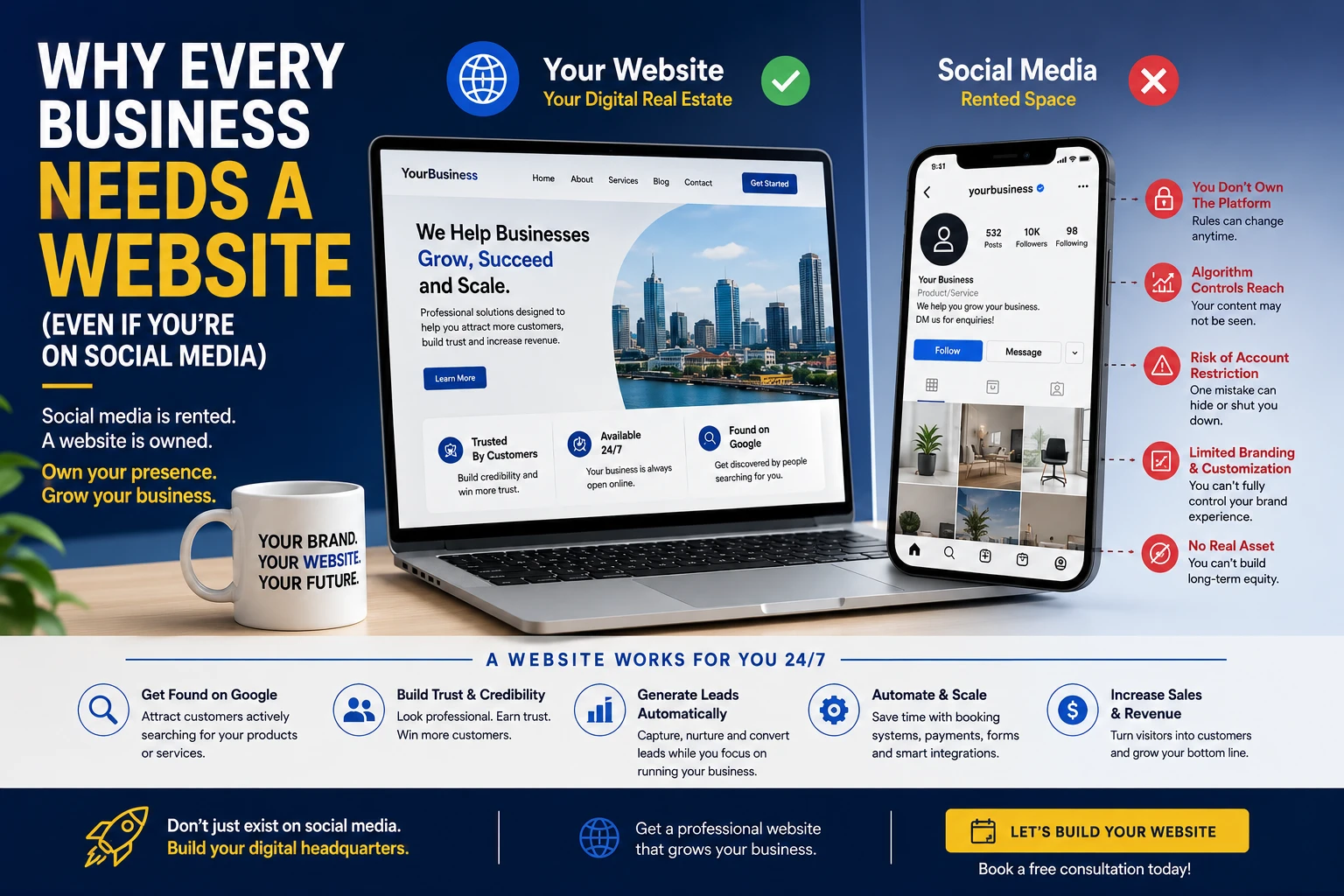
2. “Rented Space” vs. “Owned Digital Real Estate”
This is the most important concept in modern business growth.
Facebook Page = Rented Space
Social platforms provide access.
But ownership stays with the platform.
That means:
You do not fully control:
-
Audience distribution
-
Platform rules
-
Design structure
-
User experience
-
Customer relationship architecture
Potential risks include:
-
Algorithm updates
-
Temporary restrictions
-
Policy enforcement
-
Reduced visibility
-
Account access issues
Additionally, social platforms generally prefer users remain inside their ecosystem, which can reduce exposure for content designed to move users elsewhere.
You are building on infrastructure you do not control.
Website = Owned Digital Real Estate
A website changes everything.
You control:
-
Your domain
-
Your branding
-
Customer journey
-
Conversion flow
-
Integrations
-
Analytics
-
Growth systems
Customers intentionally visit your destination.
No feed competition.
No disappearing reach.
No algorithm deciding whether your customer can see your offer.
This is what digital real estate ownership looks like.
And unlike social platforms, websites become stronger business assets over time.
3. Head-to-Head Comparison Matrix
Here’s the practical difference.
| Parameter | Dedicated Business Website | Facebook Business Page |
|---|---|---|
| Data & Asset Ownership | Complete ownership and control | Limited ownership and platform dependency |
| Search Engine Visibility | Can rank locally and globally on Google | Limited discoverability outside platform |
| Credibility & Trust | Strong professional positioning | More vulnerable to impersonation and lower trust signals |
| Customization & Automation | Unlimited possibilities | Restricted platform structure |
| Lead Generation | Advanced forms and workflows | Primarily messaging |
| E-commerce Capability | Full checkout flexibility | Limited commerce controls |
| SEO Growth Potential | Long-term traffic compounding | Minimal long-term search equity |
| Scalability | High | Moderate |
The benefits of a business website extend far beyond appearance.
It becomes business infrastructure.
4. How a Website Transforms Traffic Into Revenue
Most people think websites are digital brochures.
Modern websites do much more.
They function like an automated business system.
Capture Customers Through Local Search
When customers search:
-
“best bakery near me”
-
“website developer in Lagos”
-
“cleaning service nearby”
-
“consulting company”
Your website can appear.
This is the power of local SEO for small business.
You become visible exactly when customers are ready to buy.
Build Automated Conversion Systems
Your website can automate:
-
Lead capture
-
Appointment booking
-
Payment collection
-
Proposal requests
-
Customer onboarding
Instead of:
“Send us a DM.”
You create:
Visit → Action → Conversion
Make Marketing Smarter
Websites allow advanced tracking.
Examples:
-
Conversion analytics
-
Audience segmentation
-
Visitor insights
-
Retargeting campaigns
You stop guessing.
You optimize.
That’s difficult to replicate inside a social profile alone.
5. The Winning Framework: The Ecosystem Strategy
This is not a war between websites and Facebook.
Smart businesses use both.
But each tool serves a different role.
Facebook = Attention Engine
Use it for:
-
Reels
-
Community building
-
Awareness
-
Engagement
Website = Conversion Hub
Use it for:
-
Selling
-
Booking
-
Collecting leads
-
Educating customers
-
Generating revenue
The flow looks like this:
Social Media → Website → Lead → Customer → Retention
This approach protects your growth from platform dependency.
Final Thoughts: Stop Building Your Business on Borrowed Land
Social media is powerful.
But relying on it exclusively creates risk.
Algorithms change.
Reach fluctuates.
Platforms evolve.
Your website remains.
When comparing website vs facebook page for business, the strongest businesses rarely choose one.
They use social media to attract people.
They use websites to convert and scale.
Secure your brand’s independent digital real estate.
Build a professional website designed to automate operations, improve credibility, capture demand from search engines, and create a predictable growth engine for your business.
Your next customer should not depend on whether an algorithm decides to show your post.

Comments: